
Isabella County Three-Day Releases
The Isabella County Sheriff does not publish a rolling 72-hour released-person feed. Its official inmate-search landing page sends readers to the current roster and VINELink. The page describes a person who may be lodged in the jail, not a history of all departures over three days. There is no official three-day selector, published update cycle, or public statement about how long a released record remains online.
A useful 72-hour product must be reconstructed from an existing Isabella County jail record for a defined span. This is broader than checking one person today. It asks for all final releases the Criminal Justice Center physically processed between two local endpoints. That span can cross days, a weekend, or a holiday. The result should be read with its release authority and destination so community releases do not get mixed with state, federal, immigration, or other-county transfers.
Check Isabella County 72-Hour Releases
Start by fixing the date range. “Last 72 hours” can mean a rolling period counted back from the moment of the request, while “the last three calendar days” can mean complete local dates. State both endpoints and the local time basis. An exact window lets the Sheriff’s Office locate an existing jail register, release log, daily summary, or export without guessing which part of a day belongs in the request.
- Write the start and end as local dates and times. For full calendar days, state 12:00 a.m. on the first date through 11:59 p.m. on the last date.
- Check the current Isabella roster only to see who may still be lodged. Do not subtract the current roster from an earlier screenshot to create a release list.
- Search VINELink for a named person when a custody event needs quick corroboration. Match the reporting agency and identity before using the status.
- Call jail and inmate information at (989) 772-5915 for a current operational question. A phone check is not a substitute for an all-person date-range record.
- Submit a focused request for the existing release register or export and list the fields needed. Ask staff not to create a new custom report.
- Use the 76th District Court and 21st Circuit Court paths to interpret bond, dismissal, sentence, time served, or another court action connected to a particular event.
- Follow any transfer destination. Use MDOC OTIS for a state-prison transfer, or the named receiving agency when another system took custody.
The narrower Isabella County 24-hour release list process is better for a same-day event and pickup planning. The three-day method is designed for a complete date band, especially when more than one calendar day must be covered.
Isabella County 72-Hour Release Fields
There is no county-published data dictionary for a 72-hour release list. These are request fields supported by the researched jail-record inventory, not columns promised by an online feed. A focused request should connect each person to one booking and one physical event. If a field is exempt or not maintained in the requested record, the Sheriff’s response may redact it or say it was not found.
| Requested field | Use within the three-day window |
|---|---|
| Name and booking number | Distinguishes people and repeated bookings with similar names. |
| Booking date and time | Connects each release to the correct Isabella County stay. |
| Final release date and time | Places the physical processing event inside or outside the stated window. |
| Release type or authority | Shows whether the recorded basis was bond, court order, sentence completion, or another category. |
| Transfer destination | Prevents a handoff to another agency from being called community release, if public. |
| Court and case number | Points to the docket or signed order that supplies legal context. |
Ask for an existing electronic export or register. A public-record request does not require the Sheriff to build a custom database, answer questions, or calculate a release history that the agency does not keep in that form. The final jail entry is strongest for physical time. The court record is strongest for the legal authority. VINE is a timely notification and status layer, not the certified source sheet.
Note: Specify whether both endpoints are inclusive so an event near midnight is not counted twice or left out.
Isabella County Weekend Release Records
A three-day window is useful when a same-day check misses an event that occurred on an earlier calendar day. Yet Isabella County’s published materials do not say that a Sunday or holiday release date is automatically processed on Friday. They also do not publish standard exit hours. Court transmission, holds, property and account work, transport, and another agency’s acceptance can affect when a person physically leaves.
Use the actual processed date and time, not the date someone expected to leave. If a judge entered an order late in the week, the court docket can establish the legal act while the jail record establishes the later physical exit. If the person was transferred, the accepting system should be checked before describing the outcome. A weekend roster no-result proves only that the person was not found in the current view at the time checked.
For a named person whose release may fall anywhere in the period, the Isabella County released-inmate lookup covers the county roster, VINE, OTIS, district and circuit courts, and federal fallbacks. It also explains why each system has a different scope.
Note: Do not move an expected Sunday or holiday release to an earlier date unless the actual Isabella jail record supports it.
Request Isabella County Three-Day Releases
Local jail records go to the Isabella County Sheriff’s Office FOIA contact, 5270 E. Remus Rd., Mt. Pleasant, MI 48858. Email foiasheriff@isabellacounty.org, call (989) 772-5911 for the Sheriff’s FOIA contact, or use fax (989) 317-4272. The county FOIA page provides the request form, public summary, and procedures. The form is helpful but not mandatory.
A date-range request can say: “Please provide the existing record of all final releases physically processed from 12:00 a.m. [start date] through 11:59 p.m. [end date], including name, booking number, booking date/time, release date/time, release type or authority, and transfer destination if recorded and public. Please email the record in its existing electronic format.” This wording identifies a record and does not demand a new narrative.
The county form states a five-business-day response period and permits one ten-business-day extension. The response may grant access, partially grant it, deny it, give a fee estimate, request an allowed deposit, point to a web record, or say no responsive record was located. Production can therefore take longer than the initial response. Ask for an itemized estimate before costs pass a chosen limit.
Michigan’s local law-enforcement retention schedule treats inmate jackets and daily-count summaries differently. An inmate jacket can include booking cards, sentence material, property forms, transfer papers, inmate-release forms, bonds, and warrants. A daily summary may include names processed through intake or released that day. Those schedules do not prove Isabella created every item or that every part is public, but they help identify the kind of existing record to request.
Isabella County 72-Hour Roster Limits
The public Isabella roster is configured for current offenders only. Its underlying application can retain release-related data internally, but the public setting suppresses released people. The technical retention value is not a public three-day view. It is not a promise that a user can retrieve everyone released over a weekend, and it does not establish the time at which a specific record vanished.
The public structure also supports a “Scheduled Release Date” field for a current person. That is a forecast, not proof of departure. A historical release field may be blank on a current record. Neither should be transformed into a completed 72-hour list. Only the final processed release date belongs in the requested three-day record.
The successful source capture shows the current Isabella County public roster.
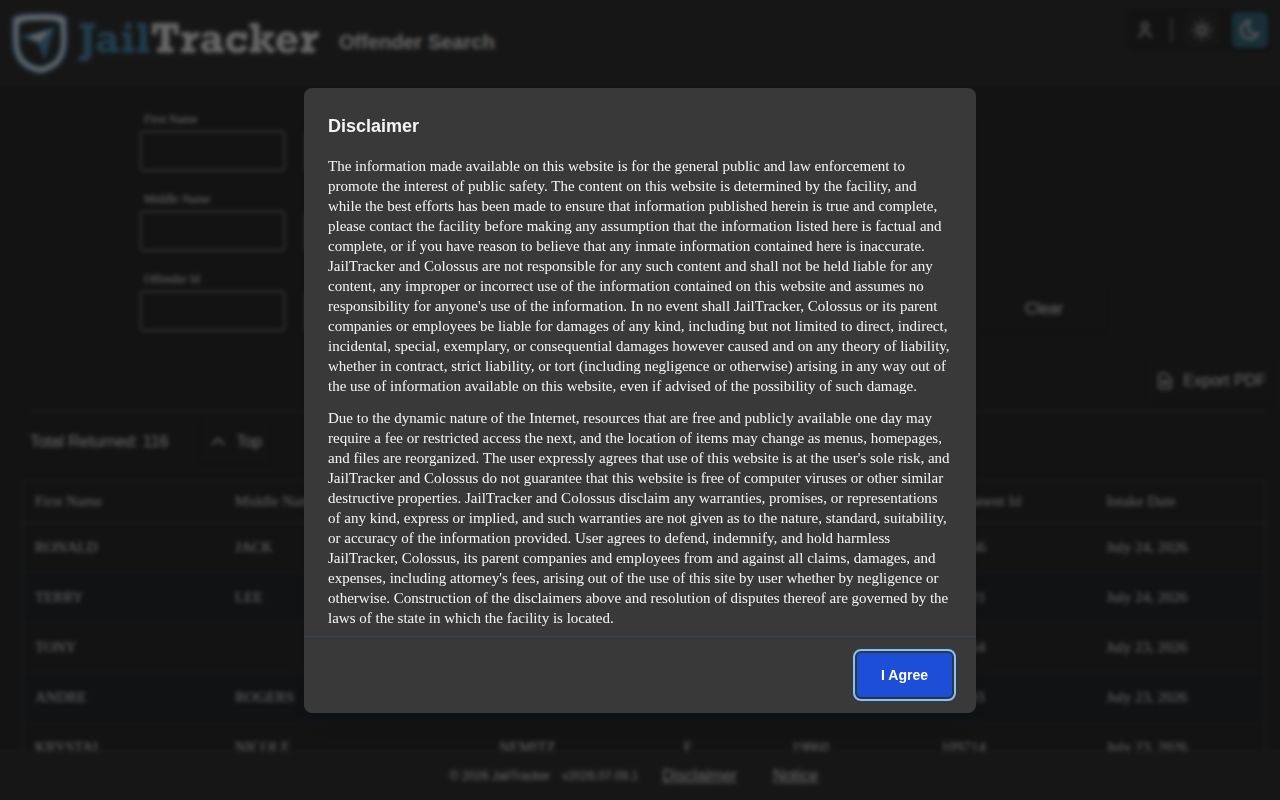
This screen documents the present-lodging search that the county supplies. It does not display a verified rolling archive of people released across three days.
Confirm Isabella County Release Destinations
“Released” describes an event in a county jail record, while “discharged” can describe the end of an agency’s legal supervision. A person transferred out of the Isabella County Criminal Justice Center has left that facility, but may remain confined. Follow the stated destination rather than treating removal from the roster as return to the community.
- Community release
- The jail stay ends and the person leaves the facility, though a case, probation, bond conditions, or another legal duty may continue.
- Transfer
- Custody moves to MDOC, another county, USMS, immigration authorities, or another named agency.
- Parole
- Physical release from state prison under continuing MDOC jurisdiction and supervision.
- Discharge
- The end of MDOC jurisdiction for the sentence, which is not the same as the earlier county jail exit.
Search MDOC OTIS when a state sentence or prison transfer is plausible. It covers Michigan prisoners, parolees, probationers, and people discharged from state supervision within its public window, but not county-jail-only cases. For a transfer to another county or federal agency, use the receiving facility or relevant system. For the legal reason, search both Isabella court levels when a felony may have moved from district to circuit court.
Note: A transfer destination is as important as the release time because it separates a custody handoff from a return to the community.
Corroborate Isabella County Three-Day Releases
Michigan VINELink can report custody status and an event date when the reporting agency supplies them. Select Michigan, search for the correct person, and compare the reporting facility and identity. A released or out-of-custody status is a timely signal, not a certified three-day jail list. No result can reflect spelling, data timing, participation, or identity, so it cannot fill every row in a date-range record.
The court path supplies legal context. Search the 76th District Court for misdemeanors and preliminary felony work, then the 21st Circuit Court after felony bind-over. Look for bond changes, dismissal, plea or verdict, sentence, time-served language, probation, and final disposition. A docket event may explain why release was ordered, while the jail’s final entry shows when processing was completed.
These records may not line up at the same moment. Note the check time for every live source. Preserve the event date from VINE and the case number from MiCOURT, then compare both with the jail register rather than forcing one display to serve as the entire Isabella County 72-hour release record.