
Isabella County Parole and Probation
Parole and probation both allow supervision in the community, but they start in different ways. The Michigan Parole Board is the sole paroling authority for felony offenders committed to the Michigan Department of Corrections. A parolee has left secure prison while MDOC jurisdiction continues. Probation is a sentence ordered by a court. It may follow a county-jail term, begin without a prison stay, or form part of a broader judgment.
A person who posts bond at the Isabella County Criminal Justice Center is not a parolee merely because the person returned to the community. Bond normally leaves the criminal case pending. Likewise, enrollment in pretrial monitoring, recovery court, treatment, or a county community-corrections program does not by itself establish parole or probation. Read the actual judgment and the current MDOC status.
| Point | Parole | Probation |
|---|---|---|
| How it begins | Release from state prison under a Parole Board decision | A sentence imposed by the trial court |
| Legal authority | MDOC retains jurisdiction after prison release | The sentencing court retains jurisdiction |
| Public status | OTIS may show Parolee and Date Paroled | OTIS may show Probationer when MDOC supervises |
| How it ends | Discharge from MDOC jurisdiction | Court or MDOC discharge under the controlling order |
The distinction affects what a record proves. “Date Paroled” usually marks physical departure from prison onto supervision. It is not the date supervision ended. “Date Discharged” marks the end of MDOC jurisdiction for that sentence, though the discharge reason must still be read before describing what occurred.
- Parole
- Conditional release from prison while MDOC authority continues.
- Probation
- A court sentence served in the community under stated terms.
- Discharge
- The recorded end of an agency's jurisdiction or supervision for a sentence.
- Absconder
- A person alleged to have stopped reporting or otherwise left supervision without authorization.
Verify Isabella County Supervision
The official starting point is the MDOC Offender Tracking Information System, known as OTIS. It covers prisoners, parolees, probationers under MDOC supervision, and people discharged within the prior three years. It does not cover a person whose only custody was the Isabella County jail. A six-digit MDOC number gives the cleanest match. Name searches should be checked against age, identity details, conviction county, court file number, and sentence information.
- Search OTIS by MDOC number when known. Otherwise enter the last and first name, then use sex, race, age, or marks and scars only when needed to narrow the list.
- Choose the status filter that fits the question. “Parolees” finds current parole status, “Probationers” finds current probation, “Discharged” finds completed MDOC supervision within the public display window, and “All” is useful when the transition is unclear.
- Open the matching record and read Status first. Then review the supervision location, county, court file number, Date Paroled, Date Discharged, and discharge reason when those fields appear.
- Use the MDOC parole and probation office directory to confirm the office named in the record. Do not assume the sheriff or county courthouse manages a state supervision case.
- Check the Isabella court judgment if the person appears to be on probation but no clear OTIS result exists. Court records show the sentence and legal terms; the office confirms current administration.
Isabella court access is split by case stage. Use the 76th District Court search for misdemeanors and preliminary felony activity, then check the 21st Circuit Court search for a felony judgment after bind-over. A related case can have entries in both systems.
For a county-jail release that did not involve a state sentence, start with the jail record and court disposition instead. The full Isabella County released inmate search separates a community release, a transfer to MDOC, and a transfer to another agency.
MDOC provides an official explanation of OTIS and its coverage. The result is a public status record, not a substitute for a signed judgment or a certified discharge document when formal proof is needed.
Note: Save the check date because an active supervision status can later change to absconder, prisoner, or discharged.
Isabella County Supervision Office
Isabella County is part of MDOC Region 5, along with Arenac, Bay, Clare, Gladwin, Gratiot, Midland, and Saginaw counties. The current directory identifies a dedicated Isabella County Parole/Probation office in Mt. Pleasant. That office is the most direct fallback when OTIS lists Isabella as the supervision location or a current status appears wrong.
Isabella County Parole/Probation
Michigan Department of Corrections, Region 5
300 N. Main Street
Mt. Pleasant, MI 48858
(989) 317-4163
The directory does not publish generic walk-in hours or a universal reporting schedule. Individual instructions control. Call before visiting, and do not infer a person's reporting terms from the office address alone.
The official MDOC directory shows how Isabella fits within the regional supervision system.
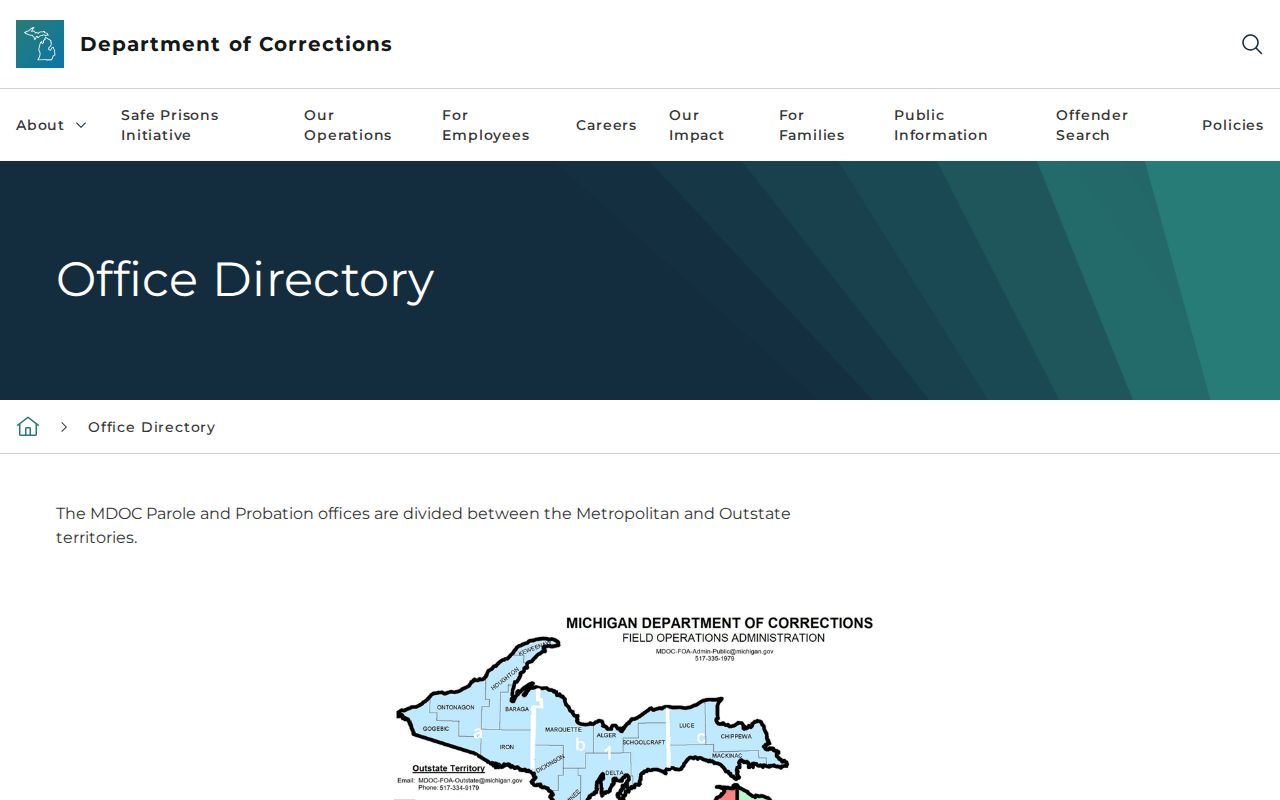
The directory view helps confirm that the office comes from MDOC, while the selected OTIS record determines whether that office applies to a particular person.
Isabella County Absconder Status
Conditions come from the controlling order and supervision instructions. They can govern reporting, travel, testing, treatment, contact, or other conduct, but no generic list proves the terms of one Isabella County case. A violation can produce added supervision action, a court response, or return to custody. It does not automatically show that a new conviction occurred.
OTIS uses specific public codes. `ABSCOND1` identifies a parole absconder sought by MDOC. `ABSCOND2` identifies a probation absconder under the sentencing county's jurisdiction. Either status describes an alleged failure to remain under supervision, not a completed discharge. MDOC advises that the whereabouts of a known parole absconder be reported to local law enforcement and lists an Absconder/Escapee Tip Line at 517-755-0855.
VINELink serves a different role. It can provide custody-change notices from a participating agency, but it is not the official source for probation terms or a final supervision discharge. If an OTIS absconder or supervision status appears incorrect, contact the listed office. Court-derived errors should be taken to the sentencing court.
Note: Never publish a private residential address or guess at a person's conditions from a general MDOC policy.
Isabella County Parole Hearing Records
Michigan does not publish a county-by-county calendar of every routine parole interview. Routine consideration is handled through the Michigan Parole Board process and may be reflected later in the person's OTIS status. The MDOC public-hearing page and department press releases cover public lifer, commutation, and pardon matters. They are not a complete routine-parole schedule.
A public notice can identify the person, the type of proceeding, the date and time, and access information. MDOC says such press notices generally appear about two weeks to thirty days before a public hearing. A Board recommendation in a clemency matter is also not the Governor's final decision.
For an individual check, search OTIS first. Then search official MDOC press releases by the person's name or MDOC number if a lifer or clemency proceeding is plausible. Possible routine outcomes include a grant, denial or continuance, and later rescission or change based on intervening events. A grant remains prospective. MDOC states that at least twenty-eight days are required between a release decision and physical departure for processing and placement work.
Isabella County Reentry Programs
Isabella County Community Corrections is separate from MDOC parole and probation. Local planning materials name pretrial assessment and supervision, Adult Recovery Court, Community Mental Health, the Strickler Center, Isabella County Restoration House, and the Alano Club as programs or partners in the local landscape. These names can help route a person who already knows a program applies.
None of those programs is a universal release locator. Participation does not prove parole, probation, or final discharge. Intake rules and availability can change, so current details should be confirmed with the program or county office before relying on an old plan. The legal supervision record remains the court judgment and OTIS where MDOC is involved.
Isabella Release Property and Corrections
The Isabella County Criminal Justice Center guide gives a useful record anchor after release. Property taken at admission is inventoried, bagged, and stored, while money is inventoried and placed in the inmate account. A released person with a property or account question can ask for the stored-property inventory and the final account disposition. The guide does not publish a release-property counter schedule, so day-of-release access should be confirmed with jail information.
Supervision-record errors take a different path. MDOC says court-derived OTIS errors should go to the sentencing court. An incorrect office, absconder entry, or other supervision fact should go to the appropriate parole or probation office. A court order may be needed before MDOC changes source information.
This split prevents a common mistake. The jail controls its intake property and release documents. The sentencing court controls its own judgment. MDOC controls the supervision display and corrects it through the office or court source that owns the disputed fact.
Note: Give each office the person's full identity and relevant case or MDOC number, but share no more personal data than needed.
Ending Isabella County Supervision
Supervision ends through discharge under the sentence and controlling order. OTIS may show `DISCHRG`, Date Discharged, and a discharge reason. That code means MDOC no longer supervises the person for that sentence. It can follow successful completion, maximum discharge without parole, or death before completion, so the reason and dates matter. Not every discharge is a living community release.
OTIS keeps a discharged public profile for three years. MDOC also lists a records-retention email for certain past prisoner records up to six years after release, while older prison history may require the Archives of Michigan. Each route is a request channel, not a promise that every record is public or still held. A set-aside can also remove a public result before the usual display period ends.
When exact proof is required, ask for the identified discharge record rather than relying on a missing search result. Michigan FOIA, MCL 15.231 et seq., governs requests for existing nonexempt public records, while the sentencing court remains the source for its own order.