
Isabella Projected and Actual Release Dates
A projected release date is a forecast based on the sentence and the facts known at the time. An actual release date records an event that has already happened. That difference matters in Isabella County. A forecast can move after a court order, a misconduct decision, a new hold, or a parole decision. The final CJC booking or jail register record is stronger proof of the time a person physically left the Isabella County Criminal Justice Center. For a state prisoner, later OTIS fields such as Date Paroled or Date Discharged describe completed events, though each field has a different legal meaning.
A person held before trial usually has no computed sentence-release date. Bond may authorize release, but the person remains at the CJC until payment or recognizance terms are accepted, other holds are cleared, and jail processing ends. A court order can also change the expected path. The signed order explains the legal authority; the jail release record shows the physical departure. If the record says transfer, the person left Isabella custody but did not necessarily enter the community.
“Discharge” also needs care. In MDOC records, discharge generally means state corrections jurisdiction ended. Parole means secure prison custody ended while MDOC supervision continued. A death-related discharge is not a community release. Read the status, reason, and date together before describing what occurred.
Find Isabella Projected Release Dates
Start with the custody system, not with a date calculator. The Isabella current roster may show a Scheduled Release Date for a current record, but that field is only a forecast. County-jail-only cases do not belong in OTIS. State prisoners, parolees, probationers, and recent MDOC discharges do. The court judgment supplies the sentence, while the jail or MDOC applies the rules that produce the working date.
- Check the official Isabella inmate-search page and follow its current-roster link. Confirm the identity, agency, booking date, and current status.
- For a CJC sentence, obtain the judgment from the 76th District Court or 21st Circuit Court as the case requires. Ask jail information at (989) 772-5915 for the computed date rather than doing the arithmetic yourself.
- If the person transferred to state prison, search Michigan OTIS by the six-digit MDOC number when known. Compare name, conviction county, court file number, offenses, and sentence dates.
- Read the OTIS status and both date fields. Earliest Release Date is parole eligibility, while Maximum Discharge Date is the outer sentence endpoint if parole does not occur.
- Verify a completed exit through the final Isabella jail record or the later OTIS Date Paroled or Date Discharged field. The broader Isabella County released inmate search explains the court, VINE, and records-request checks for past events.
Identity checks prevent a wrong match. A shared name is not enough. Use a date of birth, booking or jacket number, MDOC number, and court case number where available. Save the source and time of each search because public status data can change.
Note: A roster no-result does not prove release; it can also reflect a transfer, spelling issue, delayed feed, or another agency’s custody.
Isabella OTIS Release Date Fields
Michigan does not label one OTIS field “the guaranteed release date.” Its terms are more exact. Earliest Release Date marks the first point when the Michigan Parole Board may gain jurisdiction for an indeterminate sentence. Maximum Discharge Date is the computed outer end of the sentence if release on parole does not occur first. Date Paroled is historical evidence that prison release to parole took place in the ordinary case. Date Discharged marks the end of MDOC jurisdiction for that sentence.
The MDOC OTIS information page explains that the system covers prisoners, parolees, probationers, and people discharged within the prior three years. It excludes people whose only custody was a county jail sentence. Search fields verified for OTIS include last name, first name, offender number, sex, race, age, status, and marks, scars, or tattoos. Status choices include prisoners, parolees, probationers, discharged people, and parole or probation absconders.
The official OTIS search screen shows the state fields used to identify an Isabella County state offender:
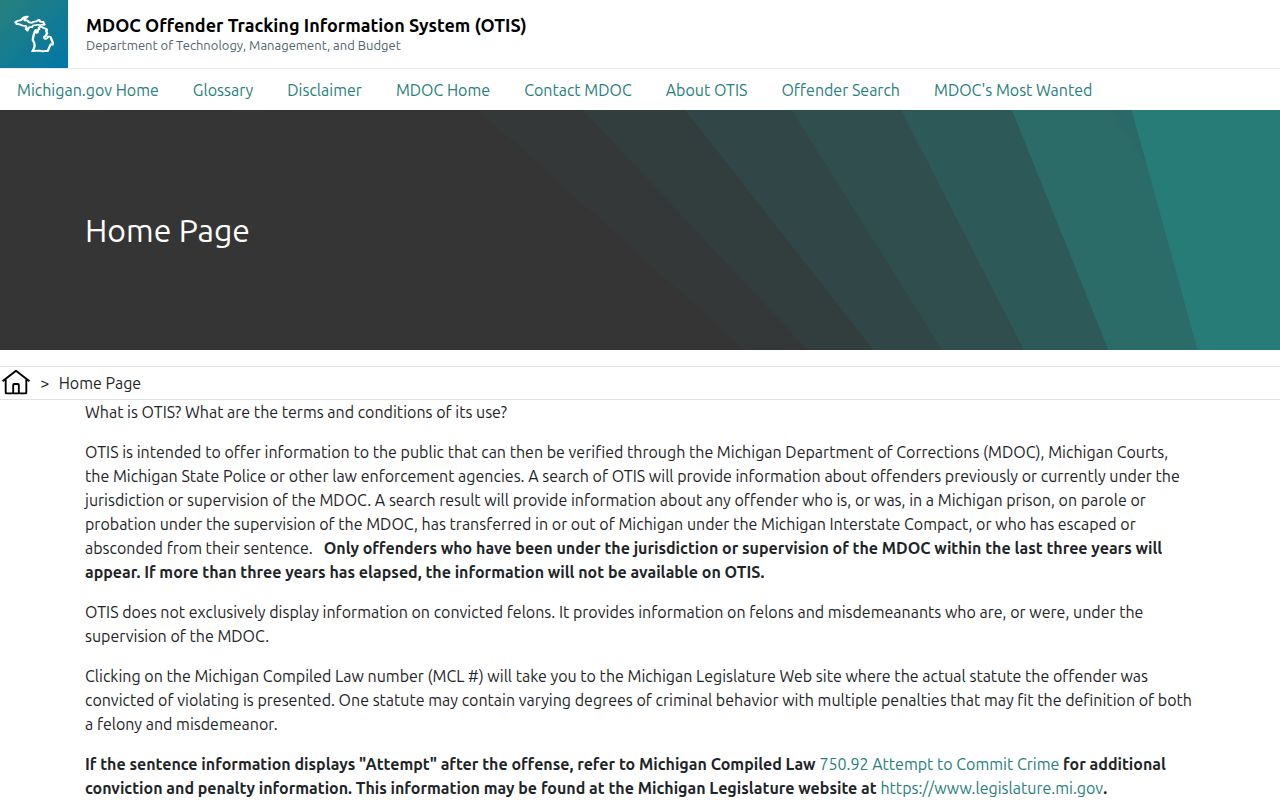
The search image reinforces why an MDOC number and status filter are useful. Open the detail record and compare the Isabella court file and sentence before relying on any date.
| OTIS field | What it means |
|---|---|
| Earliest Release Date | First parole eligibility or Board jurisdiction point, not a promised departure. |
| Maximum Discharge Date | Outer computed sentence endpoint if parole does not occur first. |
| Date Paroled | Completed move from prison to parole supervision in the ordinary case. |
| Date Discharged | End of MDOC jurisdiction for the listed sentence; read the reason as well. |
| Status | Current MDOC relationship, such as prisoner, parolee, probationer, or discharged. |
Isabella County Jail Good Time
Michigan has a county-jail-specific good-time rule. Under MCL 51.282, a county-jail prisoner whose conduct record has no violations is entitled to one day of reduction for each six days of sentence. The sheriff may set forfeiture amounts, remove earned time for insubordination, and restore lost time for a minor infraction as a reward for especially good conduct. MCL 51.283 requires the rules and allowances to be posted in the jail and places responsibility on an eligible prisoner to call the credit to staff’s attention.
This rule does not justify subtracting one-seventh from a named person’s calendar date. The actual Isabella County computation can depend on when the sentence began, credit for time already served, concurrent or consecutive terms, amended orders, holds, and any loss or restoration of good time. The CJC and court records supply those inputs. Request the jail’s computed release date or final release form when the result matters.
That county rule differs from Michigan’s state-prison framework. Modern truth-in-sentencing is not a universal “serve 85 percent” rule. For covered offenses, the judicial minimum is served in secure custody before parole eligibility. Older offenses may involve good time or disciplinary credits under the law tied to the offense date. The offense, offense date, judgment, and controlling sentence must all be checked.
Isabella Court Release Date Records
The court record supplies the legal inputs behind a county or state sentence. Isabella’s criminal search is split between two paths. The 76th District Court search covers misdemeanors and the early stages of a felony case. After bind-over, the 21st Circuit Court search is needed for the felony judgment and sentence. One arrest can therefore produce related district and circuit case numbers. Check both when the first docket stops before a final sentence.
Useful entries include the charge, plea or verdict, sentence, bond activity, jail credit, probation terms, and final disposition. The register of actions is a route into the file, not a substitute for a signed order when exact legal effect matters. A sentence described as “time served” still needs a CJC release timestamp to establish when physical processing ended. Likewise, a bond order authorizes a path out but does not prove that all holds cleared or that the person walked out at the time the judge signed it.
For a state sentence, compare the circuit court file number and conviction county with OTIS. The judgment identifies the imposed minimum and maximum terms, while MDOC computes its date fields under the law that applies to the offense. If a court later corrects the sentence, MDOC says court-derived OTIS errors should be addressed through the sentencing court. Supervision errors go to the parole or probation office shown for the person.
Older public results can have limits. Some court displays filter older criminal data, and OTIS keeps a discharged public profile for a shorter period. A no-result years later does not undo a documented Isabella release. Use the case number, request the official court record, and ask the proper records custodian for the dated event.
Isabella Release Dates That Change
A forecast can change without an error in the first record. Some events change the legal computation. Others delay the physical exit after legal authority exists. A person may also leave the CJC for another agency, which ends the Isabella jail stay but not custody. The next system must be checked before the move is called a community release.
| Factor | Effect on the release path | Best confirmation |
|---|---|---|
| Court order | An amended sentence, bond order, or credit ruling can change the legal date. | Signed order and updated jail computation |
| Good-time decision | Forfeiture or restoration can change a CJC sentence date. | Jail conduct and sentence record |
| Parole action | Eligibility does not ensure a grant, and a grant still requires release processing. | Board action and later OTIS status |
| Detainer or hold | Another agency may assume custody after the Isabella term or release order. | Transfer destination and receiving agency |
| Processing | Court transmission, property, account work, and placement can affect physical timing. | Final release timestamp |
For MDOC parole, the parole consideration process says at least 28 days must pass between the Board’s release decision and physical release. Placement review, conditions, appeals, and records work can intervene. A grant is therefore prospective, not proof that the person already left prison.
Confirm Isabella Release Dates
Use the agency that controls the record. For a CJC sentence, call jail/inmate information at (989) 772-5915 and ask whether the date is computed or completed. A formal record request can seek the final booking and release sheet, the release date and time, release authority, and transfer destination if recorded and public. The Isabella Sheriff’s FOIA contact is at 5270 E. Remus Rd., Mt. Pleasant, MI 48858, with phone (989) 772-5911 and email foiasheriff@isabellacounty.org.
For a state prisoner, check OTIS again after the expected date. Parolee status and Date Paroled are stronger proof of prison departure than Earliest Release Date. Discharged status and Date Discharged answer a different question: whether MDOC jurisdiction ended. If an old discharge has aged out of the public display, MDOC lists a records-retention channel for past prisoner records, while older state history may require the Archives of Michigan.
MI-VINE can add a timely alert for an Isabella custody change. The Isabella VINELink check explains how phone, text, and email registration works. Keep the alert, then confirm the event with the jail or MDOC record. VINE is useful notice, but it is not a certified release sheet.
Note: Record the date and time of every Isabella release check because forecasts, custody status, and public display periods can change.