
Isabella MI-VINE Release Coverage
Michigan calls the service MI-VINE. It is a free and confidential notification route for custody and criminal-case information reported by participating agencies. Isabella County confirms local participation by linking VINELink from its official inmate-search page. That local route matters because it ties the search to the Isabella County Criminal Justice Center rather than to an unrelated facility with a similar name.
MI-VINE can serve two tasks for one named person. First, a search may show custody status, the reporting agency or facility, identifying details, and an event date when the source supplies those fields. Second, a user may register for notice of a later custody change. County-jail registration can cover release, transfer, and escape. State-prison registration through VINELink covers general release, but Michigan has an additional MDOC victim-notification channel for some parole and decision notices.
Coverage follows the reporting agency shown on the person’s record. Do not assume every local jail and MDOC record has the same fields or timing. A person who leaves CJC for state prison may drop from the county roster while remaining in custody, then appear in OTIS after reception processing. A VINE transfer alert helps explain that change, but the receiving system supplies the next status.
Search Isabella VINELink Release Status
Begin at the official Isabella County inmate-search page, which links both the current jail roster and VINELink. The roster answers whether someone may be lodged now. VINELink adds custody-change status and registration. These tools are related but not interchangeable, and neither should be treated as the final certified release sheet.
- Open the official county referral, then choose VINELink. Select Michigan and the offender or custody search.
- Enter the person’s name or offered ID. Try a careful partial-name search only when spelling is uncertain.
- Compare each result’s name, identifier, reporting agency, and facility. Do not open or register against a record based on name alone.
- Read the current custody status and event date. If the record says released or out of custody, note which agency supplied the event.
- If the person is missing, check spelling, wait for a possible feed delay, and phone the CJC. For a state transfer, search OTIS as well.
The matched manifest image comes from the official VINELink search service after Michigan is selected:
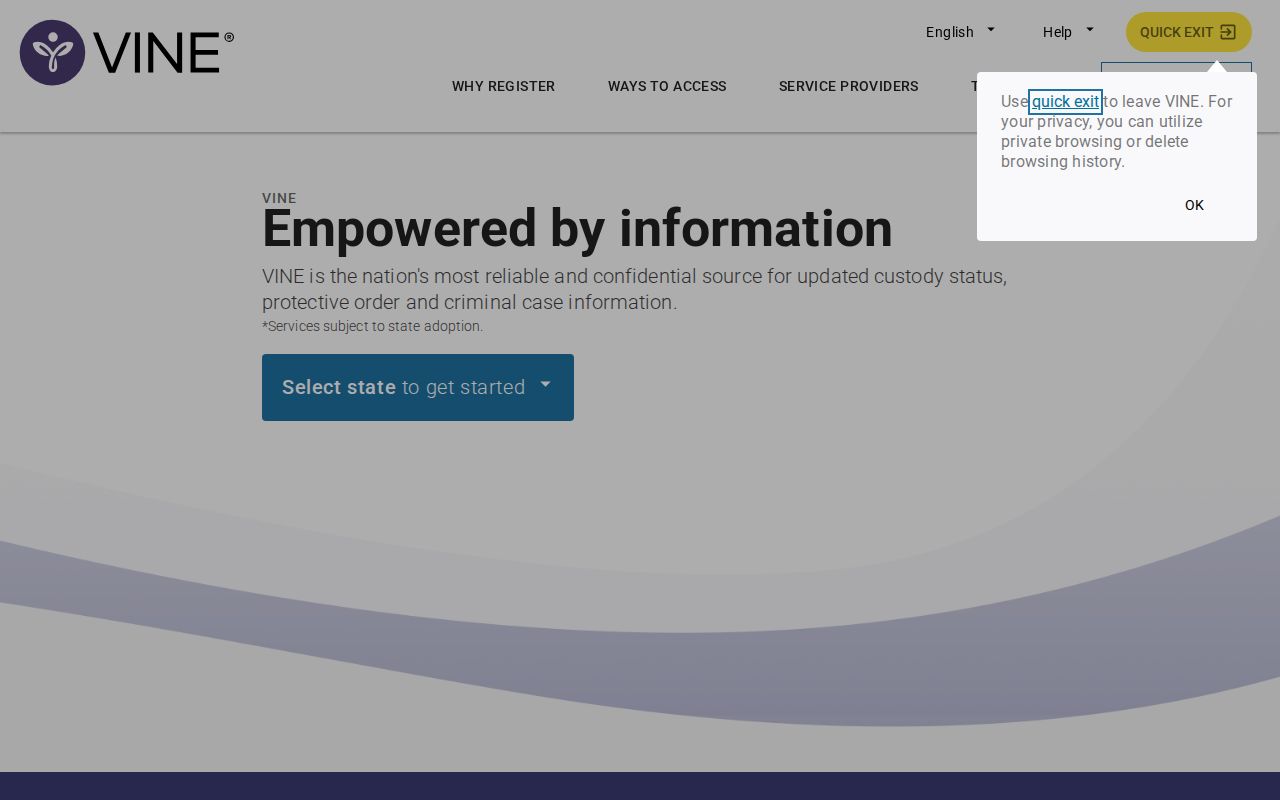
The search screen is the starting point. A reliable Isabella match still requires the correct agency and identity before a notification is registered.
For several matches, compare the full set of public identifiers. A middle name, age, agency, or offender ID can separate two people who share a name. If the system does not offer enough detail, call jail/inmate information at (989) 772-5915 rather than guessing. The Isabella released inmate search path adds district court, circuit court, OTIS, and FOIA checks when the VINE result alone is not enough.
Note: Save the time and source of a VINELink check because custody events can post after agency processing rather than at the exact moment of movement.
Isabella VINELink Release Fields
A VINE result reflects the fields supplied for that person by the reporting agency. A county result may identify the CJC, while a state result may identify an MDOC location. A release or out-of-custody status is strong, timely evidence of what that reporting agency says. It does not rule out a transfer, a detainer, a warrant, or new custody held by another agency.
| VINELink field | How to read it |
|---|---|
| Name or identifier | Use it to match the person; never rely on a common name alone. |
| Custody status | Reports the source agency’s current state, such as in custody or released. |
| Agency or facility | Shows which jail or corrections system supplied the event. |
| Custody event | May identify a release, transfer, escape, or other reported change. |
| Event date | Dates the reported change when the agency sends it; it is not always a certified timestamp. |
| Get Notified | Starts registration for the selected person and available event types. |
VINE does not replace the record behind the event. For an Isabella jail release, the final booking or jail register entry can show date, time, authority, type, and transfer destination. A court order can show why release was authorized but may not show when CJC completed processing. For a state prisoner, OTIS may later show Date Paroled, Date Discharged, and the discharge reason.
- Release
- The person left the custody of the reporting agency; another agency may still hold them.
- Transfer
- Custody moved to another facility or authority rather than ending.
- Discharge
- An agency’s legal jurisdiction or supervision ended, which differs from an earlier jail or prison exit.
- Detainer
- A request or hold tied to another authority that can affect where the person goes next.
Set Isabella Release Notifications
Register only after confirming the correct Isabella person and reporting agency. Available channels can include phone, text, email, or a web account. The interface may ask which event types to track. Choose the event that fits the need, such as release or transfer, then complete every verification step shown by the live service.
- Open the correct person’s custody detail and select “Get Notified” or the current equivalent.
- Choose an available delivery channel and enter the phone number, email address, or account details accurately.
- Select the custody events offered for that record. County participation can include release, transfer, and escape.
- For telephone registration, create and retain the requested four-digit PIN. Use the code or link supplied for text and email verification.
- Complete the confirmation and update the registration if contact information later changes.
MI-VINE is described as available around the clock, but a notification can only follow data received from the agency. A scheduled court event does not itself trigger a completed-release message. Keep a phone charged, make sure automated calls are not blocked, and maintain current contact details. More than one channel may be useful when the interface permits it.
Isabella MI-VINE Phone PIN
The phone workflow has a key detail. Michigan’s official material instructs a registrant to create a four-digit PIN. When VINE calls about an event, listen to the message, enter the PIN, and then press the pound key. That acknowledgment stops repeat calls for that event where the workflow applies. The PIN confirms receipt; it is not an offender number, jail code, or password to a court record.
Email and text notices work differently. Michigan’s material says they do not use the phone PIN and deliver a message for each change. Follow the verification link or code presented during registration. If contact information changes, update the VINE registration rather than assuming the county or MDOC will change it.
The official Isabella search page also lists VINE assistance at 800-770-7657 and TTY 866-847-1298. Those are notification-service contacts. Questions about the exact physical time CJC released or transferred someone belong with jail information or the sheriff’s record custodian.
Note: Store the MI-VINE PIN where the intended recipient can retrieve it during an automated call, but do not post it in a public message.
Isabella MDOC Victim Notifications
Michigan has a channel-specific boundary beyond the county VINE workflow. State-prison registration through VINELink covers general release. Direct crime victims who seek expanded MDOC parole-hearing or decision notices use the Michigan Department of Corrections Crime Victim Notification Unit at 877-886-5401. The two services can overlap, but they are not the same program and should not be presented as one registration.
This distinction is especially important after an Isabella County case moves from CJC to MDOC. A county VINE transfer alert may show that Isabella custody ended. OTIS then becomes the main public state-status tool. VINELink can provide general release notice for the state record, while the MDOC unit handles its own eligible victim-notification functions. The reporting agency and event type determine which channel answers the question.
Routine parole interviews are not displayed in a complete county-by-county public calendar. Michigan’s public hearing notices concern lifer, commutation, and pardon proceedings, so they should not be treated as a schedule for every prisoner. A later OTIS Parolee status and Date Paroled can confirm the completed state-prison exit. A Board grant alone remains prospective because processing and placement occur before physical release.
Confirm Isabella VINELink Release Alerts
MI-VINE warns users not to rely on it alone. A no-result can come from spelling, identity, timing, agency participation, or a move between systems. The service does not replace the BOP Inmate Locator for federal prisoners. It also does not turn a transfer into freedom from custody. If an Isabella person moved to MDOC, verify the new status in OTIS. If federal custody is plausible, use the BOP locator.
For the underlying Isabella record, contact the Sheriff’s Office. Jail/inmate information is (989) 772-5915. A focused FOIA request goes to 5270 E. Remus Rd., Mt. Pleasant, MI 48858, phone (989) 772-5911, or foiasheriff@isabellacounty.org. Ask for an existing final booking and release sheet or jail register entry, including the release date and time, authority or reason, and transfer destination if recorded and public.
When the legal reason matters, search both Isabella trial-court levels. The 76th District Court can show a misdemeanor result, bond change, or the first stage of a felony. The 21st Circuit Court can hold the later felony judgment and sentence after bind-over. A VINE release alert and a signed order answer different questions: the alert reports a custody event, while the court file explains the legal action. Pair either source with the jail timestamp when the exact CJC exit must be established.
A released result can be accurate for one agency while the person is held elsewhere. Court dockets help explain bond, dismissal, time served, probation, and transfer orders. The jail record supplies the physical CJC timestamp. OTIS supplies state status. Matching those sources prevents the common error of calling “off the Isabella roster” the same as “free from all custody.”